
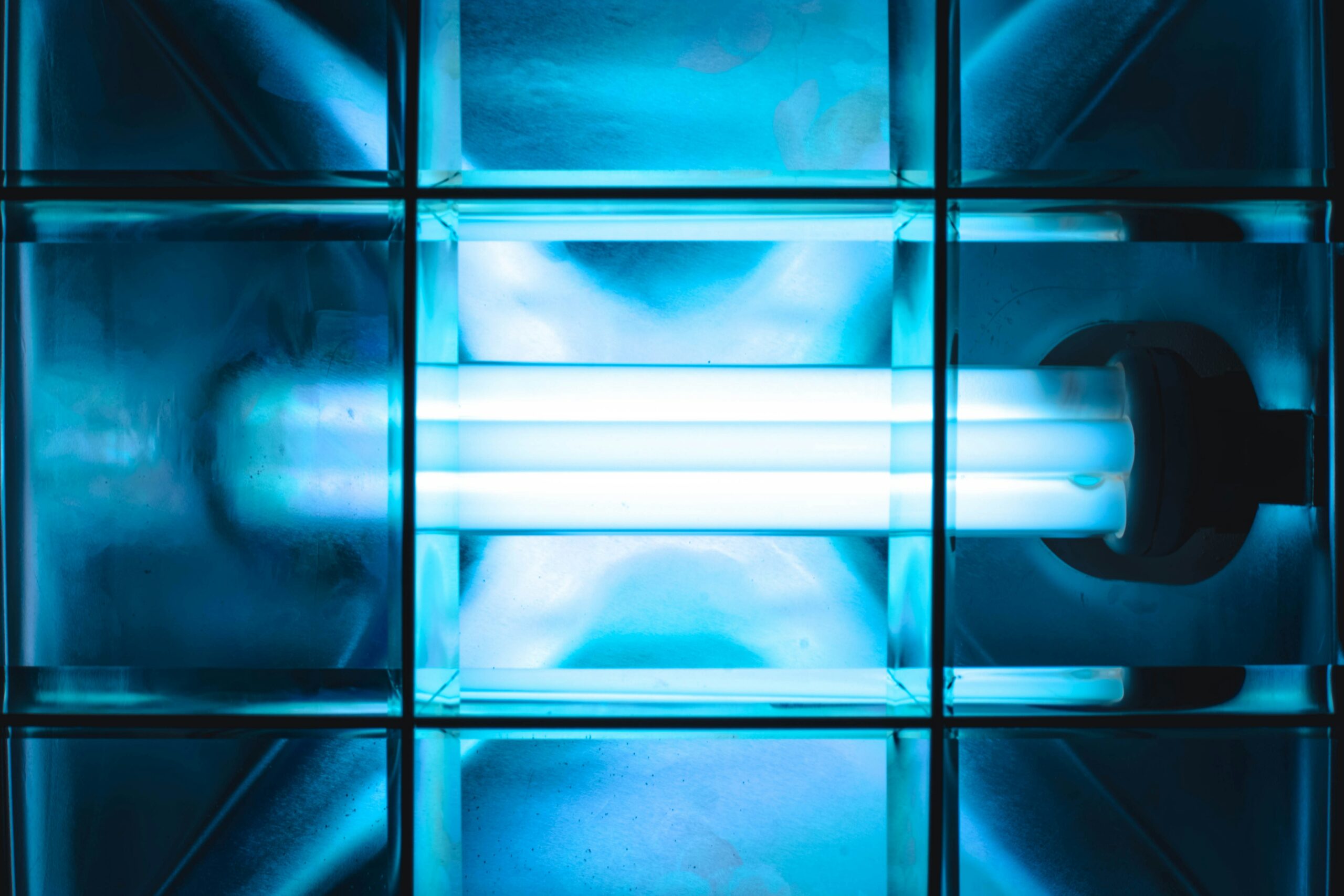
How is UV light being used in the food industry? What are its benefits? And does it have prejudicial effects on health?
Key notes
- UV-C radiation (100–280 nm, optimally ~253.7 nm) acts as a non-thermal germicidal agent.
- It is widely applied across liquids, solid food surfaces, processing facilities, and packaging.
- UV-LEDs currently face high acquisition costs and low energy-conversion efficiency for large-scale operations.
Introduction
UV radiation is a widely known and used disinfection technology for water treatment around the globe due to its high efficiency, lack of use of chemical substances, and high heat; thus, the non-existence of residual byproducts and deterioration of organoleptic properties of food products. UV light treatment has replaced the traditional method of disinfection with chlorine in a long list of developed nations and has surged as a safe and easy-to-apply alternative in household filtration systems. But how can UV light be beneficial in the food industry aside from water disinfection?
First, it is important to understand how UV light reduces or totally eliminates microorganisms from water or other food matrices. UV is a type of electromagnetic radiation that covers from around 100 nm to 400 nm of the light spectrum, this type of electromagnetic radiation can be divided into four categories: UV-A from 315 to 400 nm, UV-B from 280 to 314 nm, UV-C ranging from 100 to 280 nm and UV- vacuum ranging from 100-200 nm and it’s only transmittable in a vacuum.
It is UV-C from the 100 to 280 nm range that has a germicidal effect on microorganisms; at this range, UV light inactivates bacteria, viruses, and protozoans. UV-C light inactivates microorganisms by inducing the formation of pyrimidine dimers (cyclobutane dimer or a 6,4-pyrimidine-pyrimidone) in DNA; these compounds cause a lesion in the DNA and RNA polymerases that inhibits gene replication and expression, ultimately leading to cell death.
A wide variety of pathogenic foodborne bacteria has been found to be successfully inactivated by UV-C radiation, among them the most relevant are: Escherichia coli,
Listeria, Salmonella, Staphylococcus, Bacillus, Clostridium, Yersinia, Aeromonas, Cladosporium and Alicyclobacillus. It has been found that UV-C radiation has a germicidal effect on spoilage microorganisms (e.g bacteria, yeast and molds) such as Lactobacillus, Saccharomyces cerevisiae, Zygosaccharomyces bailii and Neosartorya fischeri.
Usage of UV-C light radiation in combination with other non-thermal novel technologies such as ultrasound, High Hydrostatic Pressure (HHP) or Pulsed Electric Fields (PEF) has been proven to work synergistically well against pathogens.
Usage of UV Treatment in the Food Industry
Currently, UV-C light treatment is used in a wide variety of food and processing operations, such as:
- Disinfection of facilities
- Decontamination of water and air
- Shelf life extension
- Safety enhancement of finished products
- Sterilization of rising water
- Sterilization of ingredient water
- Enhancement of nutritional attributes (e.g formation of vitamin D)
A wide variety of food products can be disinfected by UV-C light radiation; some of the most common products are: juices, teas, coffee, milk, sugar syrups, liquid eggs, egg components, wine and protein ingredients. UV light treatment is considered a significant improvement over traditional preservation techniques (e.g high heat) due to the absence of potential effects on the quality, flavor, or nutritional content of the food product, as well as the absence of significant by-products (e.g toxic compounds, off odors or flavors) during treatment.
Technology used for UV Light Treatment in the Food Industry
UV-C light treatment in the food industry uses conventional low- to medium-pressure mercury and amalgam lamps that emit UV-C radiation of around 253.7 nm. This wavelength is universally considered the one with the highest antimicrobial effect, and it’s considered germicidal. Novel UV-C light treatments have been developed to replace mercury-containing lamps; these are UV LED lamps. UV LED lamps are characterized by their longer life spans and capacity to operate at an optimum wavelength or a combination of wavelengths for specific applications. However, UV LED development is currently improving to be used in large-scale operations due to their low wall-plug efficiency (efficiency of conversion from electrical energy to optical energy) of around 4%, thus higher acquisition and maintenance costs.
Typical Food Products Treated with UV light in the Food Industry
A wide variety of food products can be treated with UV light with promising results of reduction or total elimination of the initial microbial load. Some of the most current examples that can be mentioned are:
| Food Product | Microorganisms inactivated | UV light wavelength | UV-C flow rate |
| Apple Juice | Lactobacillus plantarumE. coliS. cerevisiae | 254 nm | 37 mJ/cm2 |
| Pineapple juice | Total plate count, yeast,and mold | 254 nm | 10.76 mJ/cm2 |
| Black carrot juice | Total plate count, yeast,and mold | 254 nm | 0.22 mJ/cm2 |
| Liquid egg white | E. coli K12 | 254 nm | 29 mJ/cm2 |
| Milk | Salmonella spp.Shigella spp.,L. monocytogenes, andEnterobacteriaceae | 254 nm | 21.3 mJ/cm2 |
| Gouda and Manchego cheese | Listeria spp. | 254 nm | 900 mJ/cm2 |
| Chicken | S. enteritidis, L.monocytogenes, S.aureus,enterohemorrhagic E.coli, Pseudomonas spp.,B. thermosphacta, and C.divergens | 253.7 nm | 50 mJ/cm2 |
Conclusion
UV light treatment presents itself as current method of sterilization or disinfection of a wide variety of food products, surfaces and environment; thus positioning itself as a novel procedure in the food industry with several benefits in front of their traditional counterparts due to the absence of chemical substances and high heat and thus their associated effect over the overall quality of the treated food products.
References
- Koutchma, T., Popović, V., & Green, A. (2019). Overview of ultraviolet (UV) LEDs technology for applications in food production. In Ultraviolet LED technology for food applications (pp. 1-23). Academic Press.
- Koutchma, T. (Ed.). (2019). Ultraviolet LED Technology for Food Applications: From Farms to Kitchens. Academic Press.
- Singh, H., Bhardwaj, S. K., Khatri, M., Kim, K. H., & Bhardwaj, N. (2021). UVC radiation for food safety: An emerging technology for the microbial disinfection of food products. Chemical Engineering Journal, 417, 128084.


Leave a Reply