
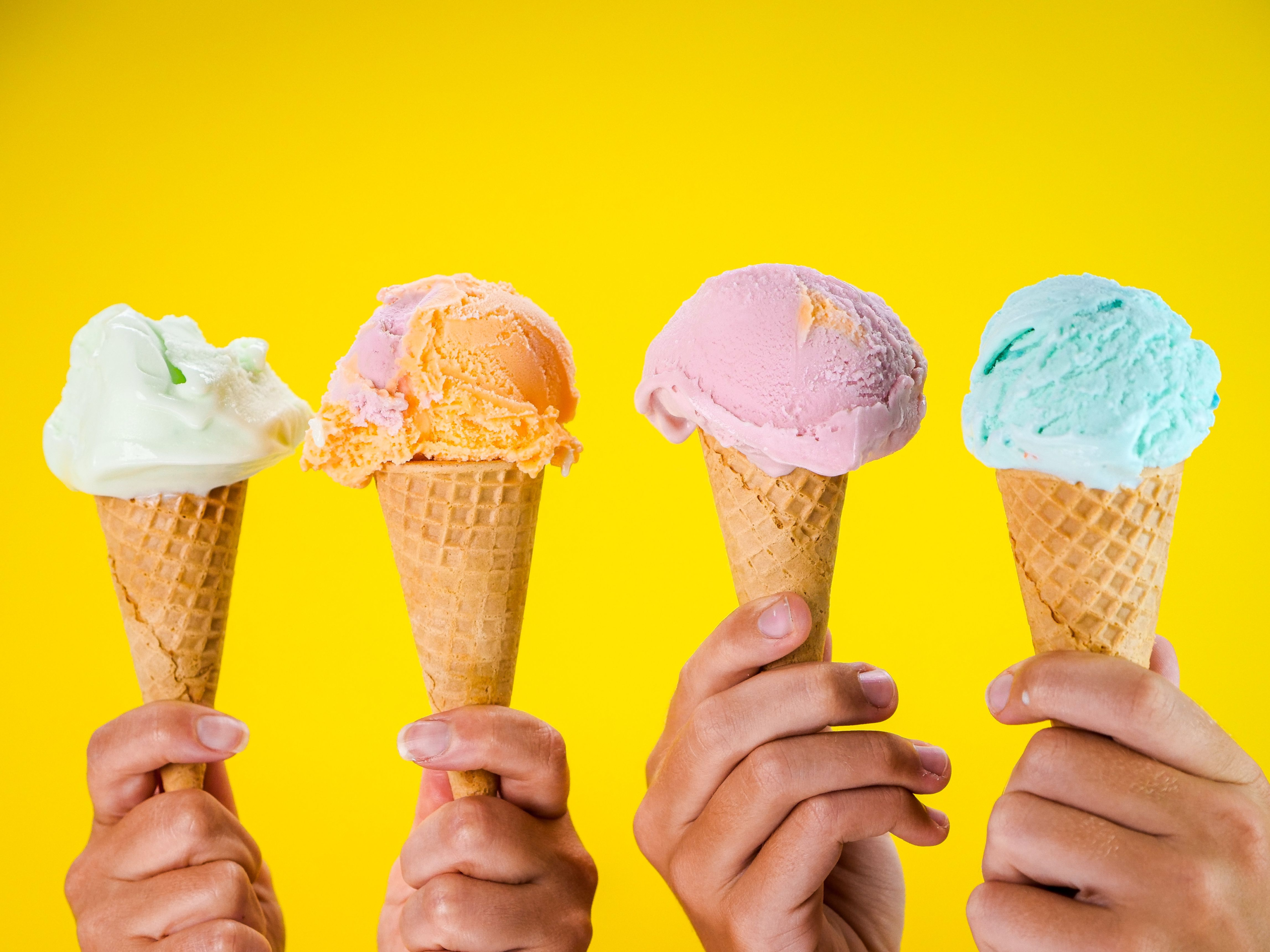
Full dairy, non-dairy, soft serve, or yogurt? All are loved around the globe, but what secrets does this beloved ice-cold treat hide?
Key notes
- Ice cream is one of the most complex food systems because all three states of matter coexist—air bubbles (gas), ice crystals and fat droplets (solids), and a concentrated sugar solution matrix (liquid)—forming a simultaneous emulsion, sol, and foam.
- Minor ingredients like emulsifiers and stabilizers (used at under 1% concentrations) prevent moisture migration during storage and retard ice crystal growth
Introduction
Ice cream is considered by many food science professionals as one of the most complex food colloids to exist, but why is this affirmation sustained by so many professionals, and why is it so difficult to replicate its rich and soft texture at home?
Firstly, it is important to extend the previous definition of what ice cream is. Ice cream is a complex colloidal mixture made originally from dairy products, sugars, and flavors. However, this definition has expanded to include a wide variety of frozen products that produce similar feelings of enjoyment for consumers.
Ice cream microstructure consists of basically ice crystals, air bubbles, and fat droplets that range from 0.1 – 1 mcr and a matrix made from a solution of sugar, polysaccharides, and milk proteins. In the following table, the proportion of each of the components is shown:
| Component | Proportion |
| Air | 50% |
| Ice | 30% |
| Matrix (sugar solution) | 15% |
| Fat | 5% |
Table 1: Concentration of large components of the colloidal system
As seen in the table, ice cream contains all three states of matter with air (gas), ice and fat (solid), and finally sugar solution (liquid), thus aiding in the complexity of maintaining the food colloid. Solids and gaseous components are found dispersed in a continuous liquid phase made from the liquid sugar solution.
Several colloidal dispersions coexist in ice cream; one of the most commonly known or recognized is the oil-in-water emulsion produced by fat droplets dispersed in the continuous sugary syrup produced by the matrix. Another type of colloidal dispersion found in ice cream is the sol; this type of colloidal dispersion is made from a continuous liquid phase (sugar solution) and solid particles dispersed in it (ice crystals). The final colloidal dispersion found in ice cream is the foam produced by the entrapped gas bubbles in the matrix.
Interactions between all of these ingredients influence product texture and overall quality. In the following section, the role of each ingredient and their influence on product quality are discussed.
Ice cream ingredients
As mentioned before, ice cream consists of a complex colloidal system made of a wide variety of ingredients; these ingredients can be classified into three large groups: major ingredients, minor ingredients, and inclusions.
Major ingredients are considered to be present in large quantities in the product; these include milk protein, fat, sugar, and water. Minor ingredients are found in small quantities, around 1% or less, and are usually emulsifiers, stabilizers, colors, and flavors. Finally, inclusions are all other ingredients added to the ice cream mixture to create or add novel characteristics to the final product, such as chocolate, cookies, wafers, fruits, nuts or chips, but do not influence the ice cream colloidal structure.
A typical formulation of ice cream can be seen in the following table:
| Ingredient | Composition (wt%) |
| Water | 60-72 |
| Total solids | 28-40 |
| Sugars | 12-16 |
| Fat (Butterfat or vegetable fat) | 7-15 |
| Lactose | 5-7 |
| Milk protein | 4-5 |
| Stabilizer, emulsifiers and flavors | 0.5 |
Table 2: Classic ice cream formulation1
Milk proteins
Milk proteins usually refer to casein and whey proteins; they have two main functions in the ice cream system. One of them is the stabilization of the water’s continuous emulsions and foams due to their surface activity that aids in the formation and stability of the air bubbles in ice cream. Secondly, milk proteins contribute to the distinctive dairy flavor of conventional ice creams.
Sugars
Sugars are usually used in all kinds of ice creams in a wide variety of types, from glucose, sucrose, fructose, and lactose. The main functions of this ingredient are to provide sweetness to the product and the amount of ice present in the ice cream, and thus influence the softness of the final product. Sugars aid in ice crystal regulation by decreasing the freezing point of water and the rate of ice crystal formation; a conventional ice cream has an ice content of around 55% by weight at a temperature of – 18 oC (-0.4 oF).
Fats
Fat is an extremely important ingredient in ice cream formulation due to its influence on final product texture and flavor. Both vegetable and animal fat are commonly used in the production of ice creams. They typically have a fat content of around 8 – 20% fat depending on the quality class of the product. High-quality ice cream has higher fat contents ranging from 15-20%. Fats have several functions in ice cream systems, starting from their role in the stabilization of the foam, it influences the creamy final texture of the product, it regulates the melting rate of the ice cream; and it’s the vehicle for a lot of fat-soluble flavor molecules.
Water
Water is a major component in ice cream; it can come from a variety of sources such as milk and sugar syrup; and it’s used as the medium where the majority of the ingredients are dissolved or dispersed. Water turns into ice crystals during the freezing process.
Emulsifiers
Emulsifiers are substances that aid in the stabilization of the colloidal systems; they are usually proteins, mono- or diglycerides, and can come from a variety of sources such as lecithin from egg yolk or simply added directly to the mixture.
Stabilizers
Stabilizers are substances used in ice creams at very low concentrations of around 0.2% to aid in a variety of functions in ice cream making. Some of the most relevant functions are:
- Aid in final product smoothness
- Regulate the meltdown rate
- Prevent moisture migration during storage
- Mask ice crystals during consumption
- Processing transport
- Aid in the foaming process
Flavors and Colors
Flavors can come from a variety of sources; vanilla, chocolate, strawberry or other essences are added to evoke a particular flavor in the ice cream system. Colorings, for their part, can be added to improve product acceptability by consumers, due to the possibility of evoking memories or sensory responses that are associated with the flavor of the ice cream.
Inclusions
Inclusions are other ingredients added to the product to produce an interesting companion to the ice cream colloidal systems but do not influence the colloidal systems overall. This can be chocolate chips, nuts, cookies, wafers, and other products.
Conclusion
Ice cream is one interesting and complex colloidal system that evokes an overwhelming feeling of happiness and joy in consumers of all ages and nationalities. It can be considered the world’s favorite frozen treat, but as seen, it hides a wide variety of interesting and challenging concepts for food scientists throughout the world.
References
- Clarke, C. (2005). The science of ice cream. Chemistry and Industry, 24(19).
- Rohrig, B. (2014). Ice, Cream and Chemistry. ChemMatters, 6-7.


Leave a Reply