
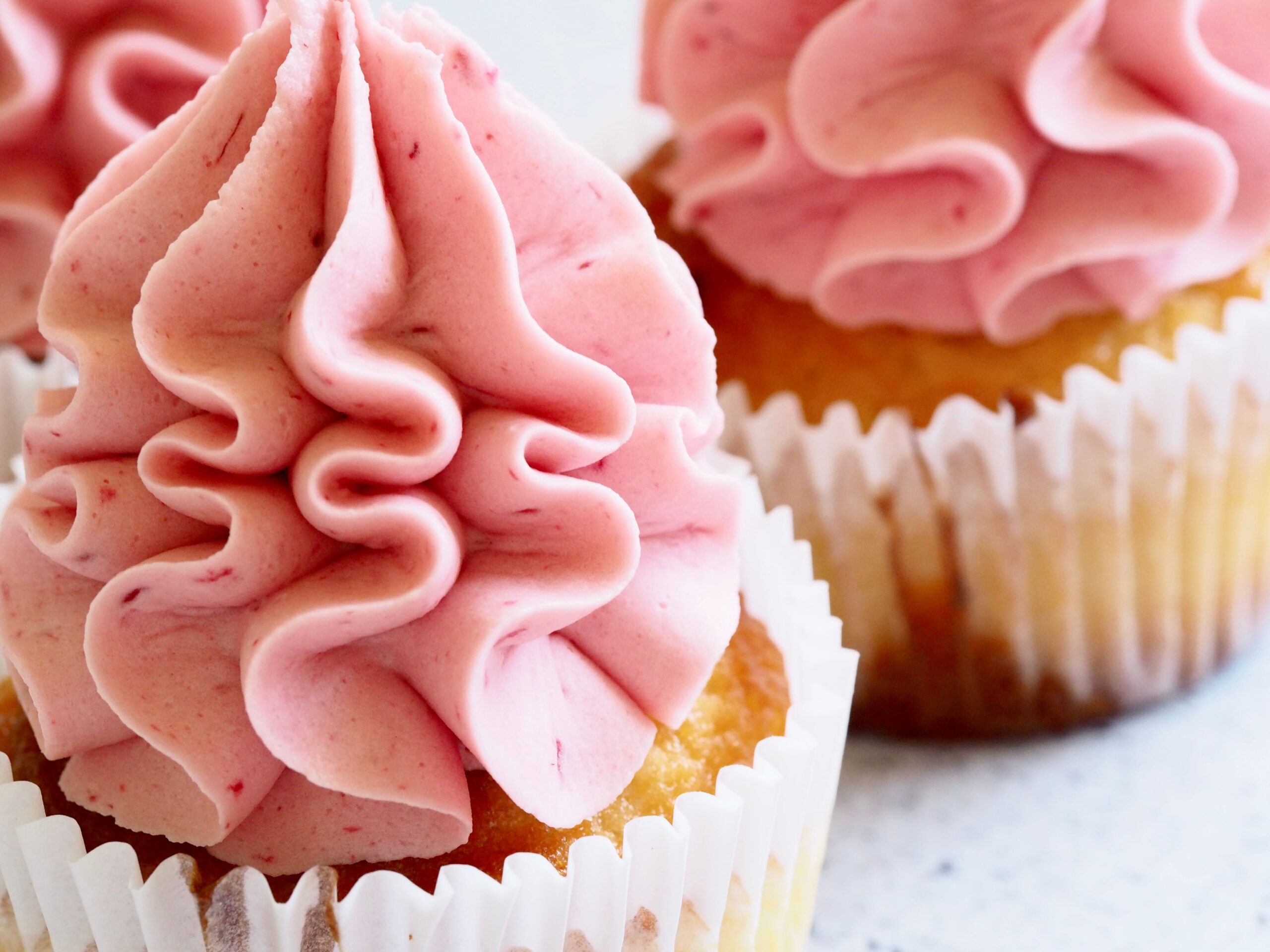
Italian, Swiss, German, or classic American buttercream is considered cupcakes’ favorite topping; but what distinguishes all these delicious toppings?
Key notes
- Buttercream is a water-in-oil emulsion where water droplets are suspended in fat, made stable through mechanical force (beating) and natural emulsifiers like egg lecithin.
- The six main types of buttercream—Italian, American, Swiss, German, Old-Fashioned, and French—differ based on whether their structure relies on meringues, cooked milk/flour bases, pastry cream, or direct creaming.
- Precise temperature control (like cooking sugar syrup to 115 oC (240 oF) or heating Swiss meringue over a double boiler) and slow incorporation of butter are critical to preventing the emulsion from collapsing.
Buttercream is one of the most beloved classic frostings for cakes, cupcakes, brownies, and cookies. However, what exactly is buttercream?
Buttercream is a water-in-fat emulsion made with butter and sugar in its most basic form, and fat, eggs, and sugar in the most novel forms. However, now that we know that Buttercream is an emulsion, a question may be raised for all of you non-scientific readers; and it may be, what exactly is an emulsion?
Emulsions are substances that are composed of two liquids or substances that would not normally mix well together. As is the case with water and fat (e.g oil, butter or shortening), due to their hydrophilic and hydrophobic properties, respectively. So, how can two substances that do not mix together overcome their differences and mush together into the sweet treat known as buttercream frosting?
For emulsions to happen, one of the liquids or substances has to be dispersed (dispersed phase) as small droplets in the other one (continuous phase). Depending on what substance corresponds to one or the other phase, two main classifications of emulsions can be made: water in oil (W/O), where the continuous phase is the oil and the dispersed phase is the water, and the oil in water emulsion (O/I) that corresponds to the contrary of the previously mentioned emulsion. Buttercream, for its part, is classified as a water-in-oil emulsion, where small droplets of water exist in a fat matrix made out of butter or shortening.1
Now that emulsions have been defined, it can be explained how they can exist. Emulsions can be made by mechanical force (e.g mixing, beating, and whisking), however, this can be unstable due to the intrinsic nature of the components, thus the force (surface tension) that avoids their mixing must be broken apart. The breakdown of this surface tension can be accomplished with physical force as mentioned before; however, it may not work in the long run, and thus the use of additives such as emulsifiers is required. Emulsifiers are surface-active substances that adhere to the surface of other substances (e.g oil or water), forming a protective membrane that prevents the coalescence of the substance with other similars to them, and thus allowing for the formation of the emulsion. 1,2
In buttercream and in most baking applications, the most commonly used and intrinsic emulsifiers are eggs. Eggs contain a substance called lecithin; this component is a mixture of several phospholipids (e.g phosphatidylcholine and phosphatidylethanolamine) that reduce the surface tension between immiscible liquids, allowing them to form an emulsion.2
Depending on the ingredients and techniques used, buttercream frostings can be classified in the following types:
Italian Buttercream
It is a characteristic frosting for wedding cakes, and it’s made with the base of an Italian meringue. Its making process is similar to a French Buttercream, with the substitution of egg yolks for egg whites. Italian buttercream is made with sugar, water, egg whites, butter, and vanilla extract. Like French Buttercream, the Italian version starts with the production of a sugar syrup; this consists of the dissolution and boiling of the water and sucrose up until it reaches a temperature of 115 oC (240 oF). While the syrup reaches its desired temperature, egg whites are beaten at low speeds. Once the temperature is reached, the syrup is slowly poured into the egg whites, and the whisking should continue until stiff peaks are reached. During the beating process, butter should be slowly added to the mixture; this may cause a collapse of the egg white peaks. If the mixture collapses, keep beating until it reaches its full volume once again.
American Buttercream
This type of buttercream is made with butter, shortening, confectioner’s sugar, and vanilla extract. Initially, the butter is creamed together with the shortening and the sugar; once the desired texture is accomplished, the vanilla extract is added for flavor.3
Swiss Buttercream
This buttercream is based on a Swiss meringue. Swiss meringue is made by heating egg whites and sugar in a double boiler or “Baño de María.” This will cause the dissolution of the sugar in the egg white’s moisture while pasteurizing the egg whites, producing a safer-to-eat and shelf-stable product. Swiss Buttercream is made with egg whites, sugar, butter, and vanilla. The making process consists of initially making a Swiss meringue by heating egg whites and sugar in a double boiler until all the sucrose has dissolved. Once the sugar has dissolved, the mixture is poured into a stand mixer with a whisk attachment and whisked at medium speed until medium peaks are seen. Once the peaks are achieved, the butter is added slowly into the mixture while the whipping continues. Afterwards, the vanilla is added, and finally the speed of the mixer is increased until a buttercream with a fluffy texture is accomplished.4,5
German Buttercream
German Buttercream, for its part, is characterized by its unique makeup in comparison with previous buttercreams. It is made with pastry cream, butter, and vanilla extract. Its rich texture and characteristic yellow or off – white color are due to the presence of whole eggs, and it is inadequate for use in confections that require a white frosting. For the making of this type of buttercream, a slightly different procedure must be followed; this consists initially in the creaming of butter and sugar until light and fluffy. Once the desired creaming is reached, the pastry cream is added to the mixture while continuing the mixing process, and finally the vanilla extract or flavoring is added.4
Old – Fashioned or Flour Buttercream
This type of buttercream is characterized by the addition of flour as a thickening agent to obtain the desired viscous mass. It is made with flour, dried milk powder, milk, butter, and sugar. Initially, the dried ingredients are mixed together and then with the milk are poured into a saucepan and cooked over medium heat until a thick mass has been reached. The thickened mass is left to cool down, and meanwhile the butter and sugar are creamed together in a stand mixer. Once the milk mixture has cooled down, it is added to the creamed butter and mixed together until a nice rich texture is accomplished.6,7
French Buttercream
It is made with sugar, water, egg yolks, softened butter, and vanilla extract for flavor. Its making process starts with sugar syrup; this is made by dissolving sucrose in water and bringing the mixture to a boil until it reaches the temperature of 115 oC (240 oF). While the syrup reaches the desired temperature, egg yolks are beaten until they are thick and light. Once the temperature is reached, the hot syrup is slowly poured into the egg yolks while whipping the egg yolks. The beating is kept until the mixture cools down. Finally, the butter is whipped into the mixture in small pieces, and the vanilla extract is added.3
Summary
In conclusion, buttercream is an water in oil emulsion made with butter, sugar and eggs typically; that thanks to the use of lecithin as an emulsifier and the mechanical force applied during beating can occurred providing a sweet, rich and fluffy confection that enhances the organoleptic properties of baked goods.
References
- McClements, D. J. (2015). Food emulsions: principles, practices, and techniques. CRC press.
- O’brien, R. D. (2008). Fats and oils: formulating and processing for applications. CRC press.
- Gisslen, W. (2016). Professional Baking. Reino Unido: Wiley.
- Baking and Pastry: Mastering the Art and Craft. (2015). Reino Unido: Wiley.
- Corriher, S. O. (2008). BakeWise: The Hows and Whys of Successful Baking with Over 200 Magnificent Recipes. Reino Unido: Scribner.
- Levy Frances, D. (2022). Baking Science: Foolproof Formulas to Create the Best Cakes, Pies, Cookies, Breads and More. Reino Unido: Page Street Publishing.
- Bertinetti, H. (2013). Bake It, Don’t Fake It! A Pastry Chef Shares Her Secrets for Impressive (and Easy) From-Scratch Desserts. Reino Unido: Atria Books.


